Meet the Fellowship
Each agent in Oh My LOTR is named after a Lord of the Rings character whose qualities mirror their role in the system. Together they form a Fellowship — orchestrators, planners, workers, scouts, and advisors — each with a distinct purpose.
Agent Hierarchy
Section titled “Agent Hierarchy”frodo / gandalf (orchestrators) |-- delegates to --> samwise (executor) |-- consults --> elrond (architecture/debugging) |-- plans with --> aragorn (strategic planning) |-- analyzes --> faramir (pre-planning), legolas (review) |-- searches --> gollum (codebase), bilbo (external) |-- inspects --> galadriel (media) |-- deep work --> gimli (autonomous)Frodo — The Inspiration
Section titled “Frodo — The Inspiration”
“Even the smallest person can change the course of the future.”
Role: Driver for success — the default agent most users interact with.
Frodo receives your request, assesses complexity, and decides the best path forward. For simple tasks he rolls up his sleeves and implements directly. For complex work he delegates to specialists — firing parallel exploration agents, consulting Elrond on architecture, or handing off more complex planning and strategy to Aragorn. He tracks progress obsessively with todo lists and verifies every deliverable before reporting back.
Philosophy: Work, delegate, verify, ship. No AI slop. Frodo carries the burden of every task to its end — his code should be indistinguishable from a senior engineer’s.
| Model | Claude Opus 4.8 |
| Reasoning | Highest — complex orchestration, implicit requirement parsing, codebase maturity assessment |
| Writes code | Yes (simple/medium tasks) |
| Delegates to | All agents |
| Best for | General-purpose requests, multi-step implementations, anything you’re not sure who to ask |
Aragorn — The Strategist
Section titled “Aragorn — The Strategist”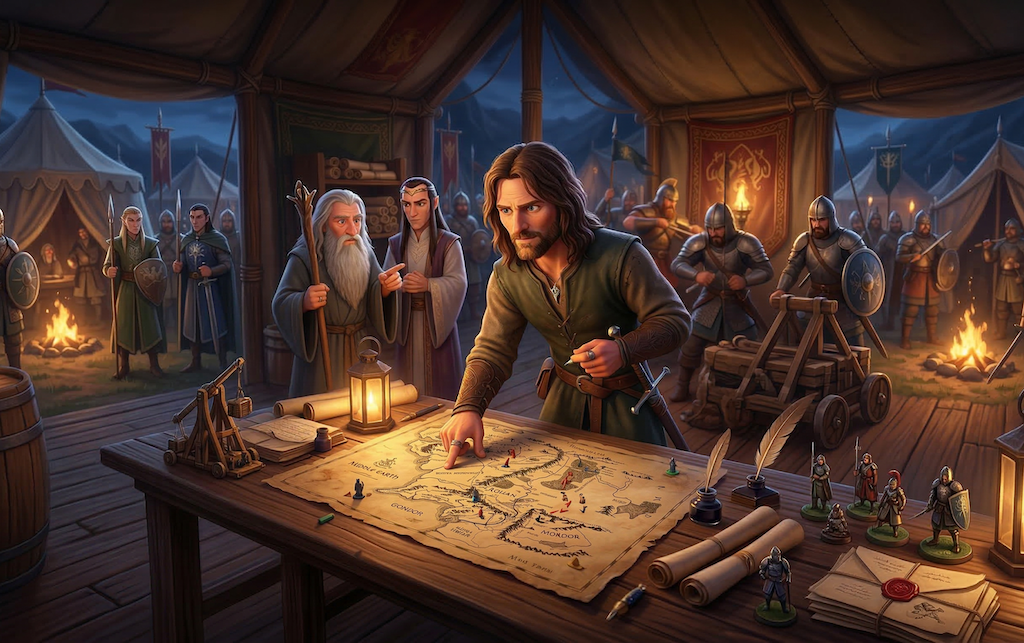
“I do not know what strength is in my blood, but I swear to you I will not let the White City fall.”
Role: Strategic planning consultant — interviews users and produces detailed work plans.
Aragorn is a planner, not an implementer. When you bring him a task, he interviews you to understand requirements, fires exploration agents to research the codebase, consults Faramir to catch blind spots, and generates a comprehensive work plan to .oml/plans/*.md. He classifies intent (trivial, refactoring, greenfield, architecture), adapts his interview depth accordingly, and structures plans for maximum parallel execution.
Philosophy: Planning is not doing. Aragorn brings the foresight of a Ranger and the strategic mind of a King. He’ll refuse to implement even if you ask — and he’ll explain why planning saves hours of debugging.
| Model | GPT-5.6 Sol |
| Reasoning | Highest — requirement analysis, scope decomposition, parallelism design |
| Writes code | No (.oml/*.md plans and drafts only) |
| Delegates to | Gollum, Bilbo, Faramir, Legolas, Elrond |
| Best for | Feature planning, migration strategies, complex refactoring plans, architecture design sessions |
Gandalf — The Orchestrator
Section titled “Gandalf — The Orchestrator”
“All we have to decide is what to do with the time that is given us.”
Role: Master orchestrator — conducts the entire workflow across a work plan.
Gandalf takes a work plan (typically generated by Aragorn) and coordinates every agent needed to execute it. He parses TODO items, dispatches tasks to the right agents in parallel waves, tracks completion, and runs the final verification wave. He never writes code himself — he conducts the orchestra.
Philosophy: Pure coordination. Gandalf wields wisdom and authority to marshal all forces of Middle-earth toward a single goal. He’s the right choice when a plan is too large or too parallel for Frodo to handle alone.
| Model | GPT-5.6 Sol |
| Reasoning | High — coordination logic, dependency tracking, multi-wave orchestration |
| Writes code | No (delegation only) |
| Delegates to | All agents |
| Best for | Executing large work plans, multi-wave parallel orchestration, release coordination |
Gimli — The Relentless
Section titled “Gimli — The Relentless”
“Certainty of death. Small chance of success. What are we waiting for?”
Role: Autonomous deep worker — explores thoroughly, then completes tasks end-to-end.
Gimli is the agent you call when you want something done start-to-finish without hand-holding. He follows a strict loop: explore the codebase, plan changes, decide whether to self-implement or delegate, execute, and verify — all in a single turn. He persists through failures, tries alternative approaches, and only asks for help as a last resort after exhausting creative alternatives.
Philosophy: 100% or nothing. Gimli endures until the job is done. He doesn’t ask permission — he acts. If verification fails, he tries a different approach. After 3 failed approaches, he consults Elrond. He never leaves code in a broken state.
| Model | Claude Opus 4.8 |
| Reasoning | High — autonomous decision-making, multi-approach problem solving |
| Writes code | Yes (primary code writer for deep tasks) |
| Delegates to | Gollum, Bilbo, Elrond, Faramir, Legolas, Samwise |
| Best for | End-to-end feature implementation, deep debugging, autonomous problem-solving, tasks requiring persistence |
Samwise — The Loyal Companion
Section titled “Samwise — The Loyal Companion”
“I can’t carry it for you, but I can carry you.”
Role: Focused task executor — does exactly what’s asked, directly and efficiently.
Samwise is Frodo’s workhorse. When Frodo or Gandalf delegates a specific, well-scoped task, Samwise executes it with the same discipline and quality standards — but without further delegation. He’s lean: no orchestration overhead, no sub-delegation chains, just clean execution with verification.
Philosophy: Dense over verbose. Start immediately, no acknowledgments. Samwise doesn’t overthink — he does the work, verifies it’s clean, and reports back. He’s the reliable companion who carries the load without complaint.
| Model | Claude Opus 4.8 |
| Reasoning | Medium-high — focused execution, pattern matching, code quality |
| Writes code | Yes (primary delegated executor) |
| Delegates to | Gollum, Bilbo (search only) |
| Best for | Well-scoped implementation tasks delegated from orchestrators, single-concern changes |
Elrond — The Wise
Section titled “Elrond — The Wise”
“I was there, Gandalf. I was there three thousand years ago.”
Role: Read-only consultant — high-IQ reasoning for architecture decisions and hard debugging.
Elrond reads code, analyzes architecture, and provides expert consultation — but never modifies anything. He’s the agent you consult when you’ve failed twice at debugging, when you’re making architectural decisions with long-term impact, or when you need a second opinion on a complex design. His reasoning quality is the highest available.
Philosophy: Wisdom without action. Elrond has seen it all — three thousand years of software patterns. He provides the insight; others execute. He’s expensive to consult, so other agents reserve him for problems that truly warrant his attention.
| Model | GPT-5.6 Sol |
| Reasoning | Highest — deep analysis, multi-system tradeoffs, architectural foresight |
| Writes code | No (read-only, consultation only) |
| Delegates to | None |
| Best for | Architecture decisions, hard debugging (after 2+ failed attempts), security/performance review, unfamiliar code patterns |
Faramir — The Scout
Section titled “Faramir — The Scout”
“I do not love the bright sword for its sharpness, nor the arrow for its swiftness. I love only that which they defend.”
Role: Pre-planning consultant — identifies what everyone else missed before the plan is written.
Faramir reviews a planning session’s context — the user’s goal, interview findings, research results — and identifies hidden intentions, unasked questions, scope creep risks, unstated assumptions, and missing guardrails. Aragorn consults Faramir automatically before generating every work plan. His output prevents costly rework by catching gaps early.
Philosophy: Defense through foresight. Faramir doesn’t plan the attack — he ensures the plan won’t fail by finding its weaknesses first. He protects what matters by asking the questions nobody thought to ask.
| Model | GPT-5.6 Sol |
| Reasoning | Highest — ambiguity detection, assumption surfacing, failure mode analysis |
| Writes code | No (analysis only) |
| Delegates to | None |
| Best for | Pre-plan gap analysis (called automatically by Aragorn), complex requirement validation |
Legolas — The Keen-Eyed
Section titled “Legolas — The Keen-Eyed”
“A red sun rises. Blood has been spilled this night.”
Role: Plan reviewer — the quality gate that work plans must pass.
Legolas reads a work plan and answers one question: “Can a capable developer execute this plan without getting stuck?” He verifies that file references actually exist, that tasks have enough context to start, and that QA scenarios are executable. He rejects only for true blockers — not style preferences or minor gaps. When he says “OKAY,” the plan is ready.
Philosophy: Approval bias — when in doubt, approve. Legolas is a blocker-finder, not a perfectionist. He trusts developers to figure out minor gaps. But if a referenced file doesn’t exist or a task is completely impossible to start, he’ll reject with a maximum of 3 specific, actionable issues.
| Model | GPT-5.6 Sol |
| Reasoning | High — reference verification, executability assessment, practical judgment |
| Writes code | No (review only) |
| Delegates to | None |
| Best for | High-accuracy plan review (optional step in Aragorn’s workflow), blocking-issue detection |
Gollum — The Deep Explorer
Section titled “Gollum — The Deep Explorer”
“We knows. We knows safe paths in the dark.”
Role: Codebase explorer — fast, fearless contextual grep across the entire project.
Gollum crawls through the codebase to find files, patterns, implementations, and structure. Other agents fire him in parallel (often 2-5 instances at once) to search for auth patterns, error handling conventions, test file placement, module boundaries, and more. He’s cheap and fast — designed to be used liberally as a search tool, not a consultant.
Philosophy: Know the dark paths. Gollum goes where others won’t — deep into unfamiliar module structures, cross-layer dependencies, and buried configuration files. He returns with what he found and moves on. No opinions, just results.
| Model | Claude Sonnet 5 |
| Reasoning | Low — optimized for speed, not analysis |
| Writes code | No (search only) |
| Delegates to | None |
| Best for | Finding code patterns, file discovery, cross-module searches, codebase structure mapping |
Bilbo — The Librarian of Rivendell
Section titled “Bilbo — The Librarian of Rivendell”
“I’m going on an adventure!”
Role: External researcher — searches official docs, OSS examples, and remote codebases.
Bilbo ventures beyond the local codebase to find answers in the wider world. He finds production-quality OSS implementations on GitHub, clones repos to read official documentation directly, and retrieves current best practices. When an agent encounters an unfamiliar library or needs to know the recommended approach for a framework feature, Bilbo is the one they send.
Philosophy: There and back again. Bilbo travels to the external world of docs and open source, gathers the knowledge, and brings it home. He’s the translator between what the docs say and what your codebase needs.
| Model | Claude Sonnet 5 |
| Reasoning | Low-medium — search synthesis, relevance filtering |
| Writes code | No (search only) |
| Delegates to | None |
| Best for | Library documentation lookup, finding OSS examples, best practice research, unfamiliar API usage |
Galadriel — The Mirror’s Keeper
Section titled “Galadriel — The Mirror’s Keeper”
“Even the smallest person can change the course of the future… if they know what they’re looking at.”
Role: Media analyzer — interprets PDFs, images, and diagrams that other agents can’t parse.
Galadriel looks into her Mirror and sees what others cannot — the content within binary files. When agents encounter a PDF spec, a design mockup, an architecture diagram, or a screenshot, they invoke Galadriel to extract structured information from it. She returns descriptions, extracted data, and summaries that text-based agents can work with.
Philosophy: Sight beyond sight. Galadriel’s Mirror reveals the truth within any visual form. She doesn’t act on what she sees — she illuminates it for others to act upon.
| Model | Claude Sonnet 5 |
| Reasoning | Low — focused on visual interpretation, not complex reasoning |
| Writes code | No (analysis only) |
| Delegates to | None |
| Best for | PDF extraction, image description, diagram interpretation, screenshot analysis |